Personalize your takeaways & insights with AI





From a collection of unrelated AI experiments to one unified AI transformation strategy.
Transforming AI Readiness into AI Direction
In part 1, we established a fundamental truth: AI readiness does not equal having licenses, running pilots, or deploying AI in isolation; it equals the certainty of scaling AI.
Most organizations have identified where they are today. However, most do not know how to get there tomorrow. This challenge is particularly pronounced in regulated industries such as banking and insurance, where AI investments must align to governance, compliance, and risk management expectations from inception.
That’s when things start getting real.
For financial services organizations, disconnected AI initiatives can quickly create operational, regulatory, and customer trust exposure when governance and accountability are not embedded from the start.
More organizations are using AI across their organization; however, very few organizations can identify tangible examples of ROI. Many areas within an organization have competing priorities. Often at the board level, CEOs are called upon to describe the status of their company’s AI program, and far too frequently those descriptions lack clarity. According to McKinsey & Company, only a fraction of organizations deploying AI are seeing meaningful ROI at scale: a challenge becoming increasingly visible in banking and insurance organizations, balancing innovation with regulatory accountability.
If AI readiness addresses whether an organization can scale AI, an enterprise AI roadmap defines how and why it will do so. In Part 1, we focused on diagnosing readiness gaps. In Part 2, we focus on translating readiness into an executable, board-approved direction.
The gap is not capability. It is direction.
The Enterprise AI Paradox: Growing Momentum with No Clear ROI
While momentum around AI adoption continues to grow rapidly in regulated industries, achieving tangible, measurable returns from AI remains elusive. Gartner highlights this gap in its research on AI strategy and planning.
Most organizations continue to follow this familiar pattern:
- Multiple AI-related experiments are taking place across different teams within the organization, including customer servicing, fraud operations, claims processing, underwriting, reconciliation, and compliance functions.
- Different teams are not collaborating regarding identifying common goals for each team's AI initiative.
- Numerous tools and platforms exist to support AI initiatives, creating additional complexity across highly regulated banking and insurance environments where data residency, customer privacy, and model governance requirements differ across functions.
- Due to a lack of clarity regarding the value proposition created by AI initiatives, business stakeholders become less interested in applying AI initiatives.
“Without a roadmap, AI generates movement but not momentum.”
Investments made in AI initiatives rarely create compounded returns. As a result, trust in AI as an enabler decreases quicker than the budget allocated to support it.
This is not a failure of technology. It is a failure of strategy and execution.
In regulated industries, it is also a failure of governance orchestration, where AI initiatives move faster than enterprise risk, compliance, and operational control frameworks can support.
Why Enterprise AI Initiatives Fail to Produce Business Value
Scaling enterprise-wide capabilities for artificial intelligence (AI) is significantly more difficult than successfully piloting an individual AI initiative.
The gap exists in how each individual AI initiative was selected, constructed, and managed.
AI roadmaps fail when ownership is architectural rather than business, particularly in banking and insurance organizations where AI decisions may directly impact customer outcomes, financial operations, compliance exposure, or risk management obligations.
Strategic Failures
- AI initiatives were chosen / built in isolation from strategic business objectives.
- Bottom-up approaches were used to identify use cases for AI initiatives rather than identifying use cases based on enterprise-wide value drivers.
- AI use cases were prioritized based on technical feasibility rather than regulatory, operational, or customer-impacting value.
Execution Failures
- Unclear ownership between business teams / technical teams.
- Success metrics were poorly defined at the beginning of the initiative.
- Governance, legal, risk, and compliance stakeholders were introduced too late into AI decision-making processes.
In banking and insurance, these failures carry additional consequences. A poorly governed AI initiative does not simply underperform; it can trigger model risk management findings, regulatory scrutiny, or reputational exposure. The cost of failure in a regulated institution is rarely contained to the original budget line.
As a result, many organizations are familiar with CEOs who can identify several separate innovation projects that produced insights but failed to produce sustainable business outcomes. Harvard Business Review has documented this pattern extensively in its research on why high-profile digital transformations fail.
Without a roadmap, an organization’s AI activities behave similarly to an R&D function: great value but separate from mainstream business outcomes.
“Isolated innovation projects & unfunded mandates generate activity — not enterprise impact.”
AI ROI does not fail because models underperform. It fails because investments lack sequencing, ownership, and governance alignment from inception.
More importantly, organizations often fail to connect AI initiatives directly to operational transformation goals such as reducing manual reconciliation effort, accelerating claims servicing, improving customer response times, reducing onboarding friction, or simplifying compliance-heavy workflows.
Common Enterprise AI Roadmap Errors
Almost every organization struggles with orchestrating innovation when it comes to AI. Almost all other organizations have identified where they stand with innovation when it comes to AI.
Orchestration Failures
- Pilots are being implemented without any logical path forward for scaling those pilot initiatives.
- Business driven prioritization did not exist for the selection and implementation of AI initiatives.
Governance Failures
- Governance was introduced late in the process, a common pattern in banking and insurance institutions where regulatory expectations require governance to precede scale pattern that Model RISK Management and NIST AI Risk Management Frameworks were specifically designed to help organizations avoid.
- Human oversight and escalation models for AI-assisted decisions were not clearly defined.
Operating Model Failures
- Decision authority was poorly defined within the operating models.
- Logical sequencing of subsequent initiatives did not exist.
- No clear accountability existed for AI-driven decisions impacting customers, compliance workflows, or financial operations.
Each factor compounds each other. What started off as innovation quickly turns into fragmentation.
Fragmentation is not a maturity issue. It is a leadership signal.
“Most enterprises don’t fail at AI because they lack innovation — they fail because they lack orchestration.”
For mid-sized financial institutions, these failures often emerge because AI initiatives are launched without a phased transformation strategy that balances operational quick wins, governance maturity, and long-term scalability.
What Constitutes an Enterprise AI Roadmap?
(and what it is not)
Significant misunderstanding exists regarding what constitutes an enterprise AI roadmap.
It is not:
- Boards often mistake AI roadmaps for architecture diagrams or tooling inventories. In practice, those artifacts answer none of the questions executives are accountable for.
- A list of available tools for supporting the enablement of AI initiatives.
- A one-time planning exercise focused solely on developing an enterprise AI roadmap.
An enterprise AI roadmap constitutes a strategic multi-year framework that connects investments in AI directly to business outcomes. In regulated industries such as banking and insurance, this roadmap is also expected to align with governance, audit, and model risk management expectations.
True roadmaps include:
- Alignment to specific business objectives (e.g., Revenue growth, Cost efficiency, risk reduction etc.).
- Logical sequence of implementing previous executed initiatives.
- Design considerations designed to ensure all aspects of the roadmap are scalable, governable and adoptable since inception.
These characteristics transform discrete experiments into a cohesive business capability. MIT Sloan Management Review identifies this shift from isolated experimentation to integrated capability as the defining marker of AI-mature organizations.
What an Enterprise AI Roadmap Engagement Actually Produces (6–8 Weeks)
To move from AI readiness to a structured enterprise AI roadmap, organizations require more than alignment; they need structured outputs that leadership can approve and execute against.
Typical engagements include:
- Interviews with executive-level personnel across various stages of the organization (e.g., business, IT, risk).
- Inventory of business-value-based use cases for inventory purposes only, aligned to corporate priorities.
- Mapping of data and platforms dependencies across systems and workflows.
- Analysis of governance thresholds defining what must exist before scale, grounded in frameworks such as Microsoft's Responsible AI Principles and the NIST AI RMF
- Identification of governance thresholds for customer-impacting AI use cases such as underwriting, fraud operations, claims handling, customer servicing, and reconciliation workflows.
- Creation of board-ready roadmap artifacts designed for decision-making purposes by executive-level personnel.
These outputs are not documentation artifacts. They exist to enable executive leadership to confidently authorize AI investments rather than passively approve them.
This transforms AI from an abstract capability into a defined, sequenced investment strategy.
Coventus' Enterprise AI Roadmap Framework
At Coventus, enterprise AI roadmaps are viewed as an executive discipline; not a technical exercise. We design our roadmaps assuming agentic AI autonomy will increase over time, particularly across regulated workflows involving customer servicing, compliance operations, financial controls, underwriting, and claims processing.
Governance thresholds are defined by use case class, not technology. We design our roadmaps to align with Microsoft Copilot, Fabric and Azure AI from day one.
Our approach is specifically designed for mid-sized banks, insurers, and brokers seeking practical AI transformation, balancing operational efficiency, governance, and phased modernization without requiring large-scale enterprise transformation programs upfront.
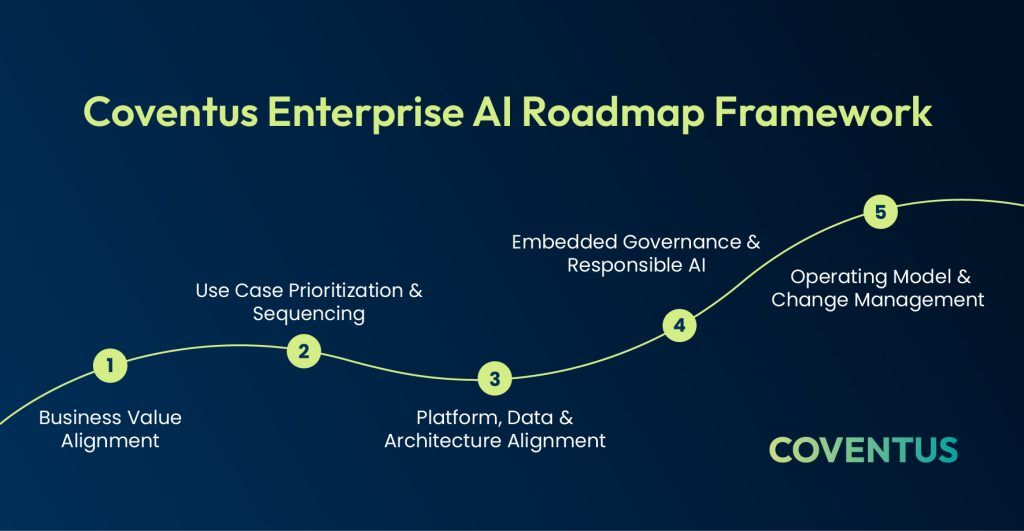
1. Business Value Alignment
Outcomes (i.e., measurable results) connected to individual AI initiatives:
- Revenue growth
- Cost savings
- Risk mitigation
- Increased productivity among employee populations
- Reduction in compliance overhead and operational risk exposure
Benefits: AI investments produce meaningful results — not just experiments.
2. Use Case Prioritization & Sequencing
Use cases prioritized and sequenced based on:
- Value created by each initiative
- Effort required to implement each initiative
- Potential risks / changes introduced by each initiative
- Regulatory sensitivity and customer-impact analysis for each AI initiative
Benefits: better investment decisions, more predictable returns. Deloitte Insights reinforces that sequenced, business-driven prioritization is a hallmark of organizations that successfully scale AI.
3. Platform, Data & Architecture Alignment
Develop strategies for platforms that will scale across the entire organization:
- Models to integrate technologies supporting deployment across the enterprise, including Microsoft Copilot, Fabric, and Azure AI Services.
- Data and content structures necessary to scale AI.
For banking and insurance clients, this explicitly includes core banking systems, policy administration platforms, claims management systems, and the data residency and lineage requirements that govern how AI can interact with customer and transaction data.
Benefits: faster transition from proof-of-concept to production.
4. Embedded Governance & Responsible AI
- Ensure compliance requirements are met from day one, in alignment with Microsoft's Responsible AI Principles and the NIST AI Risk Management Framework.
- Identify risks proactively
- Make decisions that remain defendable as the organization scales.
- Human-in-the-loop governance models for customer-impacting AI workflows.
Benefits: success without re-work/risk surprises.
5. Operating Model & Change Management
- Define roles and responsibilities across business units / departments.
- Establish decision rights and accountability structure.
- Develop chage management plans to foster adoption, informed by leading practices from Prosci
- Alignment between business, IT, risk, compliance, legal, and operational leadership.
Benefits: success without re-work/risk surprises.
Business Benefits of an Enterprise AI Roadmap for Executive Leaders
Transitioning from readiness to a structured enterprise AI roadmap provides clarity. A rare commodity in most organizations.
Some key benefits include:
- Enterprise-wide alignment with strategic business objectives.
- Well-defined investment plan with logical sequencing.
- Well-defined success metrics and tracking models.
- Visibility into risks, dependencies and governance requirements.
- Shared fact base for all executive level stakeholders.
- Improved visibility into regulatory, governance, and operational risk exposure associated with AI adoption.
Leaders gained the ability to authorize, not just approve, their organization’s AI investments.
For regulated industries, this distinction is critical because AI investments increasingly require defensible governance decisions; not simply technology approvals.
Organizations that delay this step often find governance decisions being made by default rather than by design.
“This provides leaders confidence to defend AI investments, not just approve them.”
The Enterprise AI Journey: From Roadmap to Scaled Value
Enterprise-wide adoption of artificial intelligence (AI) is not a destination. It is a capability.
The journey consists of a series of organized stages:
- Assessing readiness
- Create an enterprise-wide roadmap for artificial intelligence
- Align data, governance, operating models
- Implement priority-based use cases
- Expand responsibly under governance, guided by principles such as Anthropic's AI safety research and Microsoft's Responsible AI
- Continuously refine and improve due to outcome
Failure to follow this sequence increases risk, particularly as agentic capabilities become more autonomous. For banking and insurance institutions, sequence is not a best practice; it is a regulatory expectation. Examiners increasingly assess not just what AI is deployed, but whether the governance infrastructure preceded it.
Speed without sequence diminishes trust faster than missing targets.
The discussions made by far in this blog and the previous one would have given you insights on assessing AI readiness and building an AI roadmap. Stay tuned for Part 3 of this blog series, where we delve deeper into AI governance and why it is the key to scale AI initiatives.
If your organization is looking to adopt AI capabilities, building an AI readiness plan before making those investments is not optional but fundamental. Connect with Coventus to schedule your AI Readiness Assessment and take a structured, leadership-aligned approach to scaling AI.
Frequently Asked Questions
Share this article