Personalize your takeaways & insights with AI



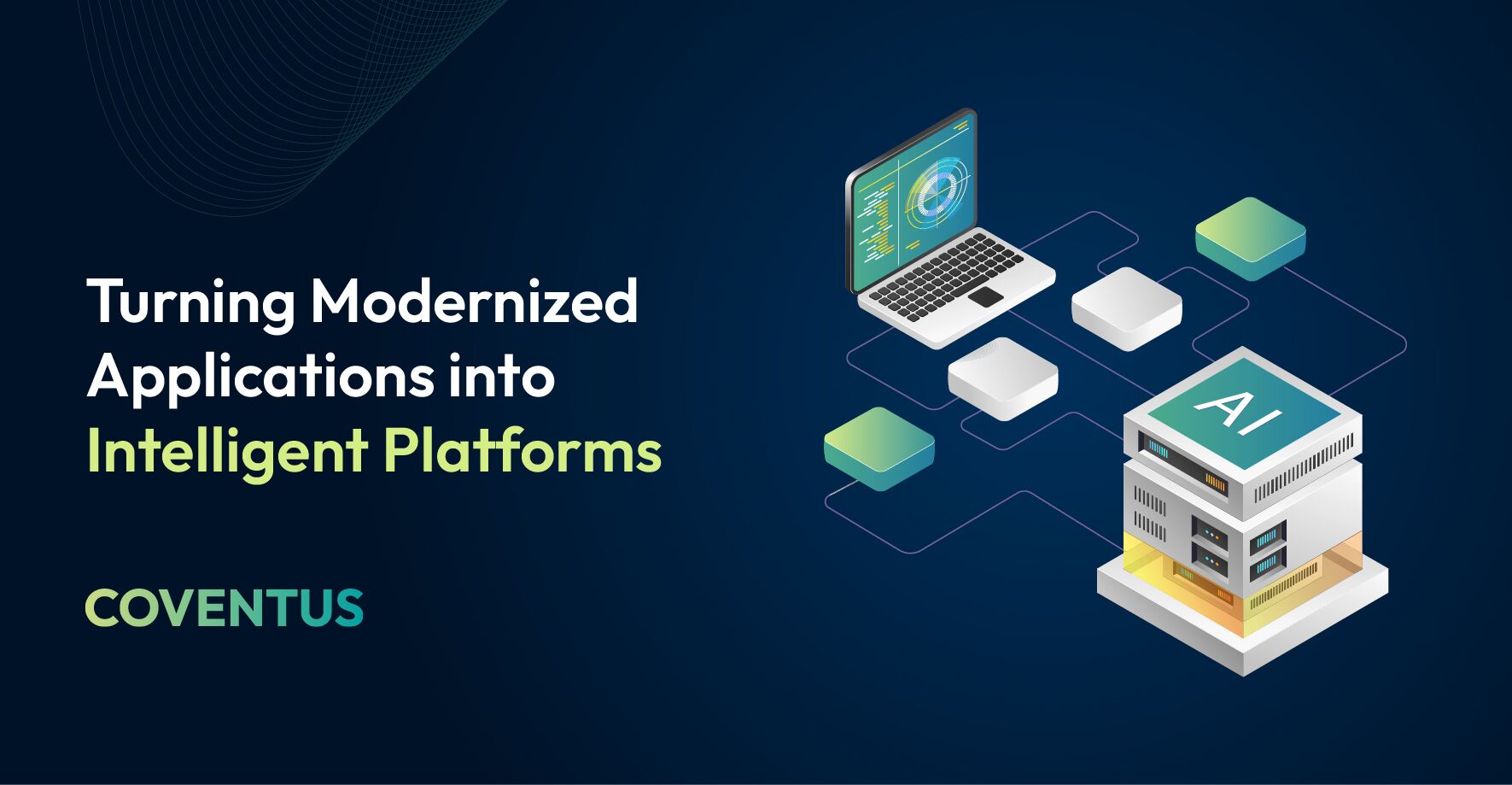
Your organization has spent years modernizing. You have migrated to the cloud, decomposed monoliths, and invested in scalability and resilience. Yet when the conversation turns to AI-driven workflows, intelligent automation, or agentic AI, the answer is often still “not yet.”
According to Gartner, 33% of enterprise software will include agentic AI by 2028, up from less than 1% today. This is the AI readiness gap, and it represents the defining enterprise challenge of this moment. The enterprises that will compete in this environment have already moved past cloud adoption debates. They are building applications capable of reasoning and acting on data in real time. At Coventus, we work with enterprises navigating exactly this shift, from modernized infrastructure to AI-ready platforms.
Modern Applications vs. AI-Ready Applications
Modernization delivered real results: scalability, resilience, and lower operational costs. But AI demands something different. The distinction matters:
| Modern Applications | AI-Ready Applications |
|---|---|
| Cloud-native | API-first + event-driven |
| Scalable | Context-aware |
| Process transactions | Enable decisions |
| User-driven workflows | Agent-driven workflows |
The difference is simple: modern applications respond. AI-ready applications participate.
The need to modernize applications is driven by four challenges:
Architectural Rigidity: Monolithic architectures, isolated data stores, and disconnected workflows leave legacy applications unable to support AI. Our approach addresses this through API-first modernization and AI-ready data access.
Lack of Intelligence Layer: Most modernization efforts focused on speed and resilience, not intelligence. As a result, legacy applications still cannot support decision-making, automation, or operational insight on their own. We close this gap with embedded analytics, automation, and AI-assisted workflows that deliver business value beyond infrastructure improvements.
No Orchestration capability: Most legacy applications operate in isolation, with no mechanism for the coordinated decision-making that agentic AI workflows require. Our modernizations introduce event-driven architectures and orchestration layers so applications can communicate, execute tasks, and support decisions across the enterprise.
Slow Release Cycles: Long release cycles and manual testing continue to delay delivery, even after an application has been modernized. Our AI-driven development lifecycle addresses this directly, shortening the time between releases while improving software quality.
Organizations are shifting toward AI-native operating models built on autonomous workflows, intelligent operations, and real-time decision support. The enterprise applications that serve as the operational backbone of these environments must balance innovation with governance and control.
The AI-Driven Development Lifecycle (ADLC)
Traditional SDLC improvements optimize individual stages. ADLC is different: it embeds AI across every phase, including code generation, automated testing, deployment, and optimization, creating a compounding effect on speed and quality.
This is where most modernization programs fail: they upgrade applications, but not how applications are built.
Our AI-driven development lifecycle includes all phases of the software development life cycle:
- Code generation using AI
- Automated quality assurance testing using AI
- Intelligent release cycles and monitoring
- Continuous optimization in production
This will significantly increase the speed at which organizations can deploy new features, reduce the risks associated with deploying them, and improve the overall quality of the features deployed. Enterprises engaged in AI-enabled modernization will benefit from the efficiency our ADLC provides.
Why Regulated Industries Feel This First
There are two extremes in regulated industries: incredible opportunity on the one hand, and regulatory compliance, auditability, and risk management on the other. The insurance industry is modernizing its policy administration systems to enable claims automation and underwriting intelligence.
A 2025 NAIC survey indicates 84% of health insurers currently utilize AI or machine learning in some form. Banking institutions are utilizing their investments in fraud detection, compliance workflows, and data governance.
Healthcare organizations are developing AI-assisted decision support tools in accordance with strict privacy constraints. These industries simply cannot afford to experience any disruption during their modernization efforts. Therefore, they will expect their modernization roadmaps to produce both innovation and resilience while providing the necessary levels of governance and oversight.
How Organizations Become AI-Ready (Maturity Path)
- 1. Modernize architecture (API-first, modular)
- 2. Expose enterprise data (real-time integration)
- 3. Embed intelligence (AI + automation)
- 4. Transform delivery (ADLC)
- 5. Enable agentic orchestration
Most organizations stop at step 2. AI leaders reach step 5.
Each step builds on the one before it, until modernized applications evolve into intelligent enterprise platforms.
The Future of Modernization Is Intelligence
The next wave of modernization is not about infrastructure; it is about intelligent applications and AI as the operational layer of the enterprise. In the coming years, organizations will not compete based on the number of applications they have. Instead, organizations will compete on who has the most intelligent applications that can think, adapt, and act.
The next wave of modernization centers on intelligent applications, with AI as the enterprise’s operational layer, rather than on infrastructure alone. In the coming years, competitive advantage will come from application intelligence, not application count. The organizations that pull ahead will be the ones whose applications can reason and adapt on their own.
The real question isn’t whether to modernize. It’s whether your applications will be ready to participate in an AI-driven enterprise. The organizations that get this right will define the next wave of competition.
Coventus helps organizations move from modernization to intelligent execution, with the governance and structure regulated industries require.
Frequently Asked Questions
Cloud readiness for banks and insurance companies starts with evaluating architecture rigidity, data accessibility, and orchestration gaps. Legacy monoliths signal that modernization must precede a cloud migration.
The best cloud adoption strategy follows a maturity path: modernize architecture, expose data, embed intelligence, transform delivery, then enable orchestration, turning legacy applications into AI-ready platforms.
Cloud modernization replaces disconnected workflows with API-first, event-driven architecture, shortening release cycles and reducing manual testing, which lowers IT costs and improves operational efficiency.
Cloud modernization prepares an enterprise for AI and automation by adding orchestration and intelligence layers, so applications move from responding to participating in future digital initiatives.
Enterprises can migrate legacy applications to the cloud without disruption by pairing modernization roadmaps with resilience planning, since regulated business operations cannot absorb downtime.
Share this article