Personalize your takeaways & insights with AI





Insurance agencies are under more pressure than ever. Rising customer expectations, shrinking margins, talent shortages, and increasing regulatory scrutiny are forcing agencies to modernize faster than they ever have before.
Automation, RPA, and AI are everywhere right now, but they are also frequently mixed up. And when the differences are not clear, agencies end up with failed projects, compliance headaches, and technology that does not pay off.
If you are an agency leader, carrier, or MGA trying to modernize intelligently, understanding the differences is not optional. It is foundational.
Let’s break it down clearly.
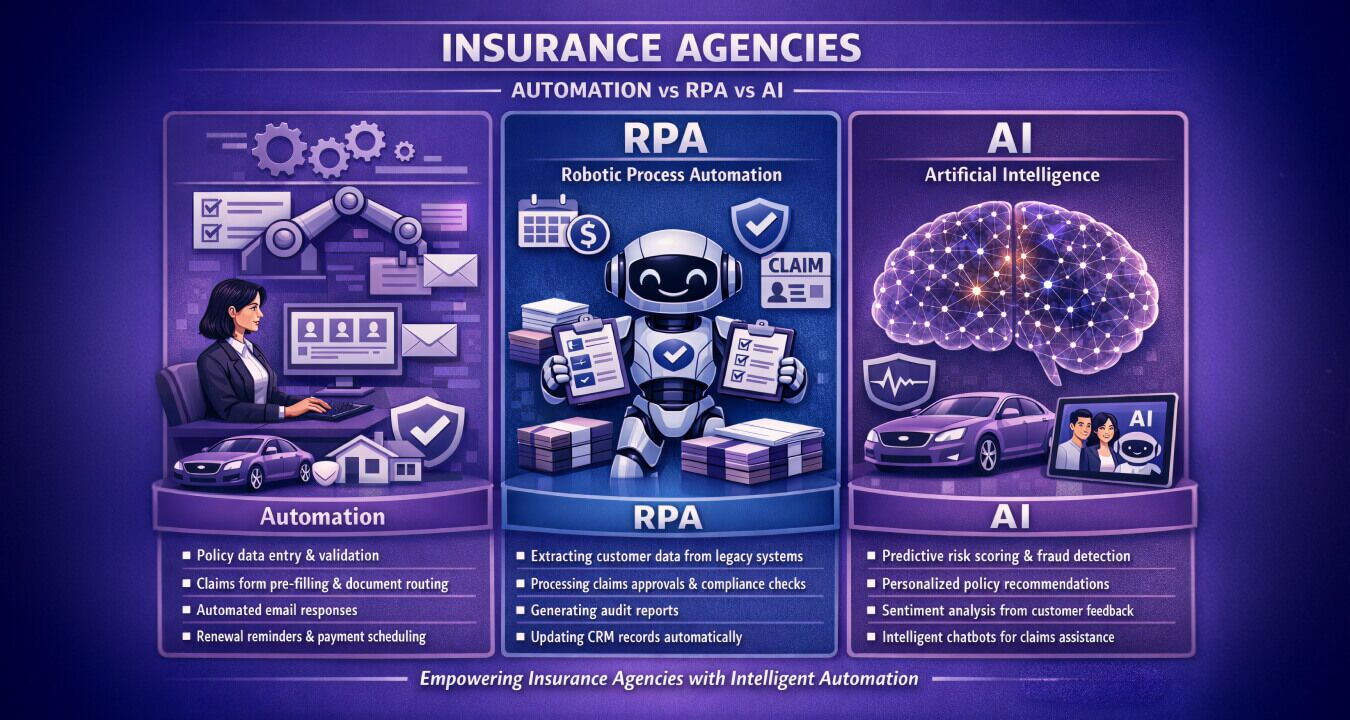
1. Automation: The Foundation of Modern Insurance Operations
Automation is the broadest category. It refers to any technology that performs tasks without manual effort.
Think of it as the digital version of “set it and forget it.”
Examples in insurance
- Automated renewal reminders
- Workflow routing (send this claim to adjusters, this submission to underwriting)
- API-based data sync between AMS, CRM, and carrier portals
- Automatic COI generation
- Rules engines for eligibility or appetite checks
Why agencies use it
- Reduce manual data entry
- Improve consistency
- Eliminate human error
- Speed up quoting, servicing, and renewals
Risk profile
Low to moderate.
Automation is rules-based, predictable, and easy to explain, which regulators and E&O carriers appreciate.
2. RPA: Automation That Mimics Human Actions
RPA (Robotic Process Automation) is a specific type of automation that uses software “bots” to mimic human actions on a screen.
If automation is the umbrella, RPA is one tool under it.
Examples in insurance
- Bots logging into carrier portals to pull loss runs
- Bots entering submission data into multiple carrier systems
- Bots reconciling commission statements
- Bots downloading policy documents and attaching them to the AMS
Why agencies use it
- Works well with legacy systems
- Fast to deploy
- Does not require APIs
- Reduces repetitive, time-consuming tasks
Risk profile
Moderate.
RPA is powerful but fragile. If a carrier portal changes its layout, the bot breaks.
Agencies must manage:
- Change control
- Exception handling
- Monitoring
- Audit trails
3. AI: Automation That Learns
AI (including machine learning and generative AI) is where things get both exciting and risky.
AI does not follow rules.
It learns patterns from data and makes predictions or recommendations.
Examples in insurance
- Intelligent document classification (ACORD forms, COIs, loss runs)
- AI-assisted underwriting
- Fraud detection
- Predictive analytics for retention or cross-sell
- Chatbots that generate responses
- Automated summarization of claims or submissions
Why agencies use it
- Better accuracy
- Faster decisions
- Improved customer experience
- Ability to detect patterns humans miss
Risk profile
High.
AI introduces:
- Model risk
- Bias concerns
- Explainability challenges
- Data privacy issues
- Drift and performance decay
Insurance regulators increasingly expect transparency around how AI influences underwriting, pricing, and claims decisions.
4. How Insurance Agencies Should Think About the Three
- Automation = Efficiency
Use it to streamline workflows and eliminate manual tasks. - RPA = Bridge for Legacy Systems
Use it when APIs don’t exist or systems can’t integrate. - AI = Intelligence
Use it to improve decisions, but only with strong governance.
5. Comparison Table: Automation vs. RPA vs. AI in Insurance
| Dimension | Automation | RPA | AI / Machine Learning |
|---|---|---|---|
| What it is | Tech that performs tasks without manual effort | Bots that mimic human clicks/typing | Systems that learn patterns from data |
| Logic type | Rule-based | Rule-based | Pattern-based, probabilistic |
| How it works | Workflows, scripts, APIs | Bots interact with screens | Models trained on data |
| Examples | Workflow routing, auto-reminders | Bot pulling loss runs | Fraud detection, document intelligence |
| Deterministic? | Yes | Yes (unless UI changes) | No |
| Explainability | High | High | Lower |
| Risk profile | Operational risk | Operational risk (fragile) | Model risk, bias, privacy |
| Regulatory lens | IT controls | IT + Ops | AI governance, fairness, transparency |
| Data requirements | Accurate input | Accurate input | Training, validation, monitoring |
| Human oversight | Recommended | Recommended | Mandatory |
| Failure mode | Workflow breaks | Bot breaks | Model drift, bias |
| Leadership question | “Is it controlled?” | “Is it stable?” | “Can we explain these decisions?” |
6. Why the Differences Matter for Insurance Agencies
Treating these technologies as interchangeable leads to:
- Compliance issues
- E&O exposure
- Operational failures
- Customer dissatisfaction
- Wasted investment
Each technology requires different controls, different expectations, and different governance.
Agencies that understand the differences modernize confidently.
Agencies that don’t risk falling behind, or worse, running afoul of regulators.
7. The Bottom Line
Automation, RPA, and AI are not the same.
They solve different problems, carry different risks, and require different oversight.
The agencies that win the next decade will be the ones that:
- Use automation strategically
- Use RPA carefully
- Use AI responsibly
Modernize your agency and streamline your insurance operations! Coventus helps you implement automation strategically and AI responsibly.
Reach out to start your automation journey.
Share this article