Personalize your takeaways & insights with AI


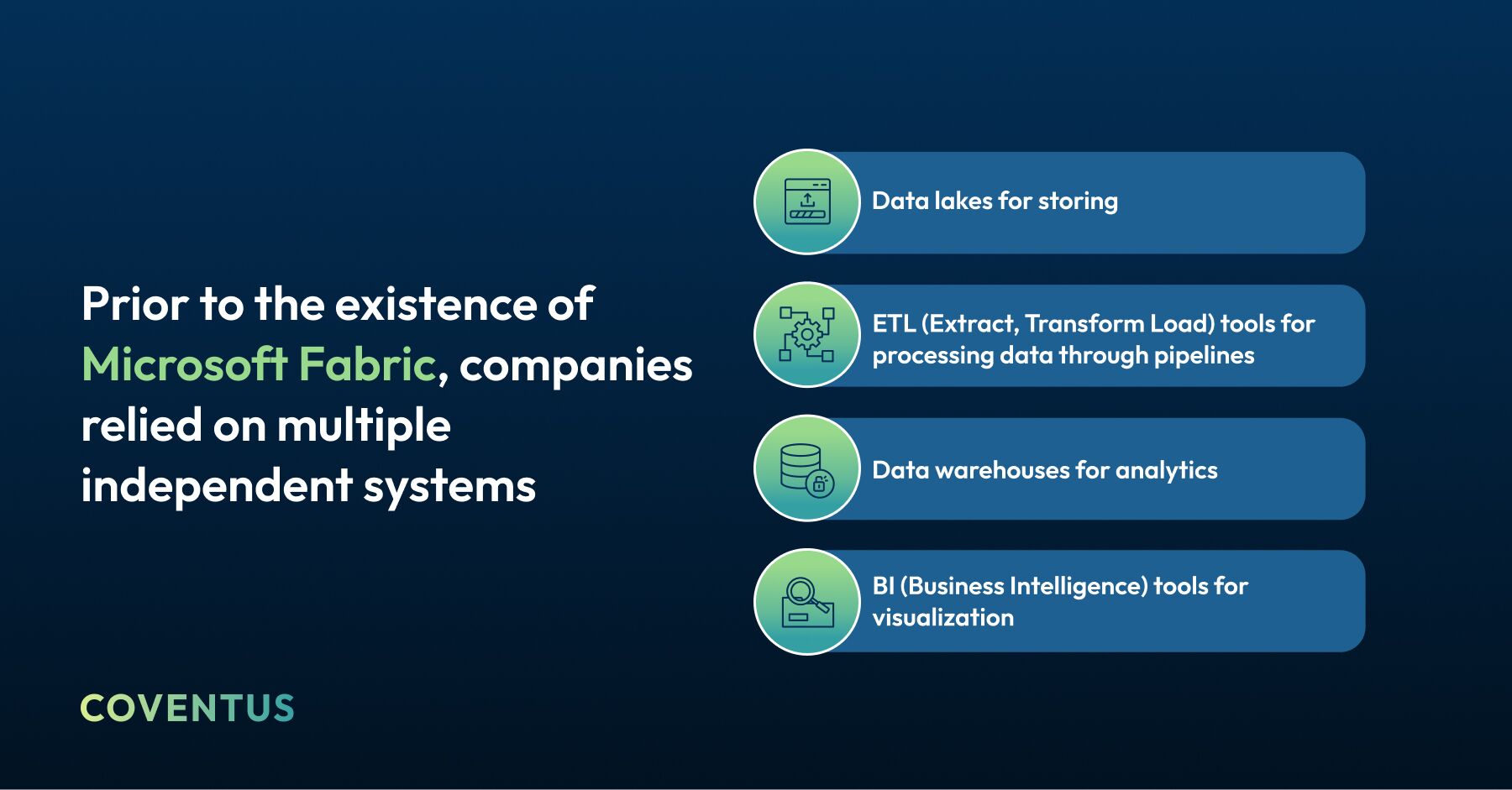
Enterprise data is expanding exponentially; however, many businesses continue to face challenges transforming that data into meaningful insights because their enterprise data is fragmented across multiple systems, legacy data warehouses, and isolated analytics applications.
Industry studies show that companies that successfully modernize their data platforms have greatly enhanced their time-to-insight and ability to make operational decisions. Traditional analytics architectures require integrating many components, including data engineering tools, data warehouses, reporting systems, and machine learning systems.
Microsoft Fabric presents a major paradigm shift toward a unified AI-ready data platform.
Fabric incorporates:
- Data Engineering
- Data Warehousing
- Real-time Analytics
- Business Intelligence
- Data Science and Machine Learning
—all as a singular cloud analytics environment.
When used with Power BI for analytics and visualization, organizations achieve a common interface for analyzing, visualizing, and acting on their enterprise data.
In addition to improved reporting, a modern Microsoft Fabric environment facilitates real-time operational intelligence, predictive analytics and AI-driven decision making across the organization.
What Is Microsoft Fabric?
The Modern Data Platform for Unified Analytics
Microsoft Fabric is a complete end-to-end data and analytics platform engineered to simplify the entire data lifecycle.
Fabric integrates these capabilities into a single platform, providing organizations with a simplified way to collaborate among data engineers, analysts, and business users.
Workloads Supported by Core Microsoft Fabric
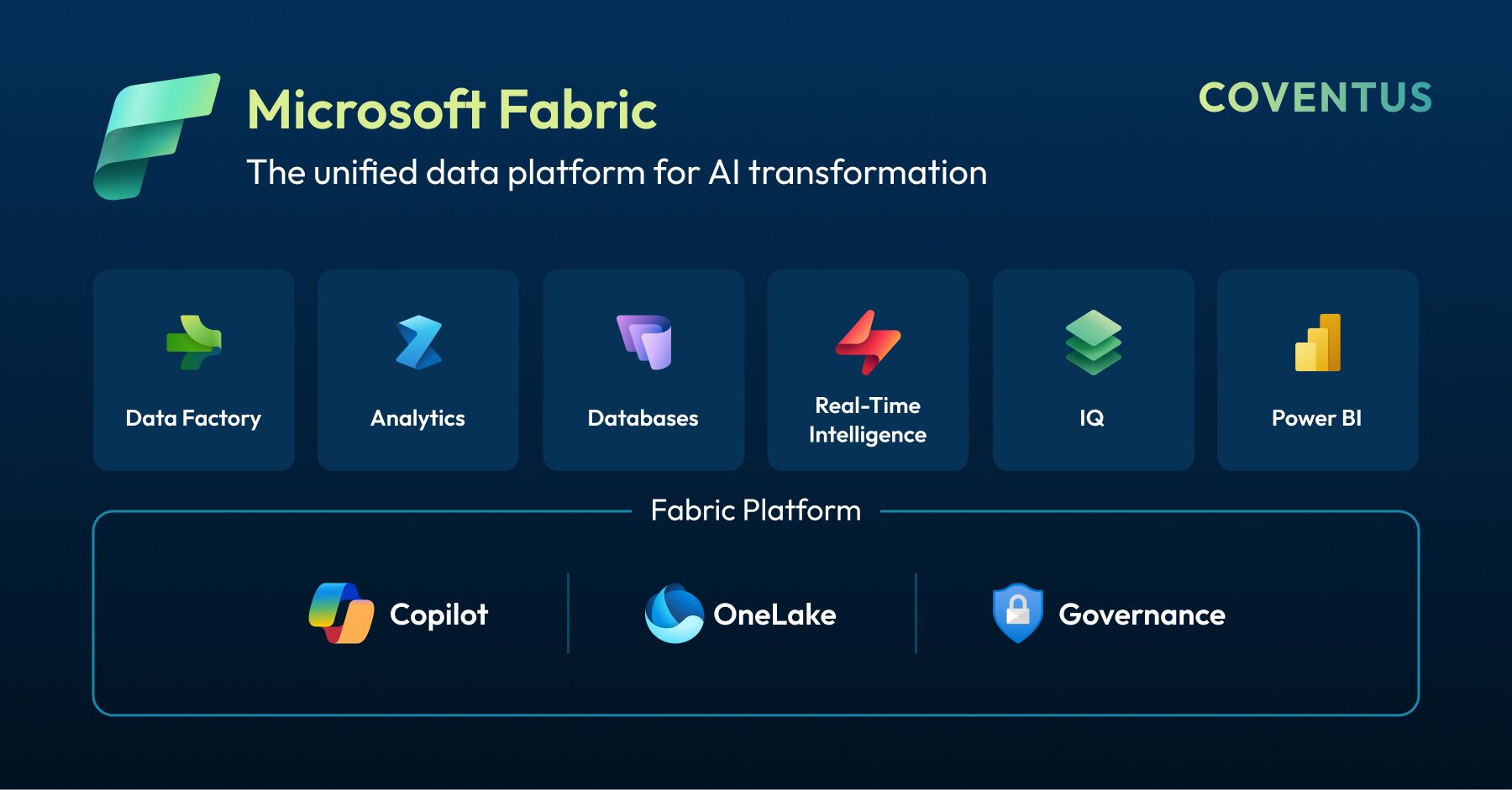
Fabric supports numerous integrated workloads throughout the analytics lifecycle:
- Data engineering
- Data factory (orchestration of pipelines)
- Data warehouse
- Data science
- Real-time analytics
- Power BI
Since these workloads run on the same data platform, organizations can easily transition from data ingestion through to analytics to AI.
AI-First Analytics with Copilot
A major differentiator of Fabric is Copilot, Microsoft’s AI assistant, which is directly embedded in the analytics workflow.
Copilot assists with:
- Generating data pipelines
- Writing transformation logic
- Creating Power BI reports
- Producing DAX queries
- Explaining analytics models
This has dramatically reduced the barrier to entry for creating advanced analytics solutions.
OneLake: A Single Version of Enterprise Data
At the heart of Fabric is OneLake, Microsoft’s unified storage architecture.
OneLake allows organizations to maintain a single version of enterprise data shared across multiple workloads, thereby eliminating duplicated data storage and disparate datasets.
Capabilities of OneLake and Lakehouse Architecture
- Shared enterprise data across analytics workloads
- Data shortcuts for connecting external data sources without duplicating data
- Domain organization for large enterprises
- Native support for open formats such as Delta Lake
This architecture makes governance simpler to manage while enabling flexible analytics workflows.
Lakehouse Architecture: The Foundation of Modern Analytics
Many organizations modernizing their analytics environments are transitioning away from traditional data warehouses to lakehouse architectures.
The lakehouse architecture model combines the best of:
- Data lakes (versatility and scalability)
- Data warehouses (performance, governance, and structured analytics)
Rather than isolating structured and unstructured data across various systems, lakehouse architecture enables all enterprise data to exist in a single analytics environment.
Benefits of the Lakehouse Model
- Simplified architecture across analytics workloads
- Improved collaboration between engineering and analytics teams
- Reduced complexity in managing infrastructure
- Interoperability using open formats such as Delta Lake
Fabric builds upon the lakehouse model by tightly integrating with OneLake and providing built-in analytics workloads.
Additional capabilities include:
- Shortcuts to external storage systems
- Mirroring of operational databases into Fabric
- Datasets shared across engineering and BI environments
This architecture provides the technical foundation for scalable data modernization.
Modernizing ETL: Data Pipelines Built for the Future
Traditional ETL systems are often built on complex custom code and fragile integrations. Modern data platforms take the opposite approach of automating, orchestrating, and maintaining low-cost pipelines.
Microsoft Fabric modernizes ETL through Data Factory and integrated engineering tools.
Options for Developing Modern Pipelines in Fabric
Organizations may develop modern pipelines using:
- DataFlows Gen2 for low-code data transformation
- Spark notebooks for advanced engineering workflows
- Pipeline orchestration across fabric workloads
- Data shortcuts to external systems
- Copilot-assisted pipeline generation
Because pipelines operate on the same platform as analytics and BI tools, organizations can avoid many integration challenges common in traditional ETL environments.
Advantages of Modern ETL Architecture
- Faster ingestion and transformation of data
- Less data duplication across systems
- Better monitoring and reliability of pipelines
- Simpler governance over workflows
- Faster migration from legacy ETL systems
These characteristics make data engineering environments far easier to scale.
AI-Powered and Real-Time Analytics with Microsoft Fabric
Modern organizations frequently require real-time insight to react to operational events as they happen.
Microsoft Fabric offers two primary capabilities that facilitate this shift.
Real-Time Analytics (KQL)
Fabric contains a Real-Time Analytics workload created in Kusto Query Language (KQL).
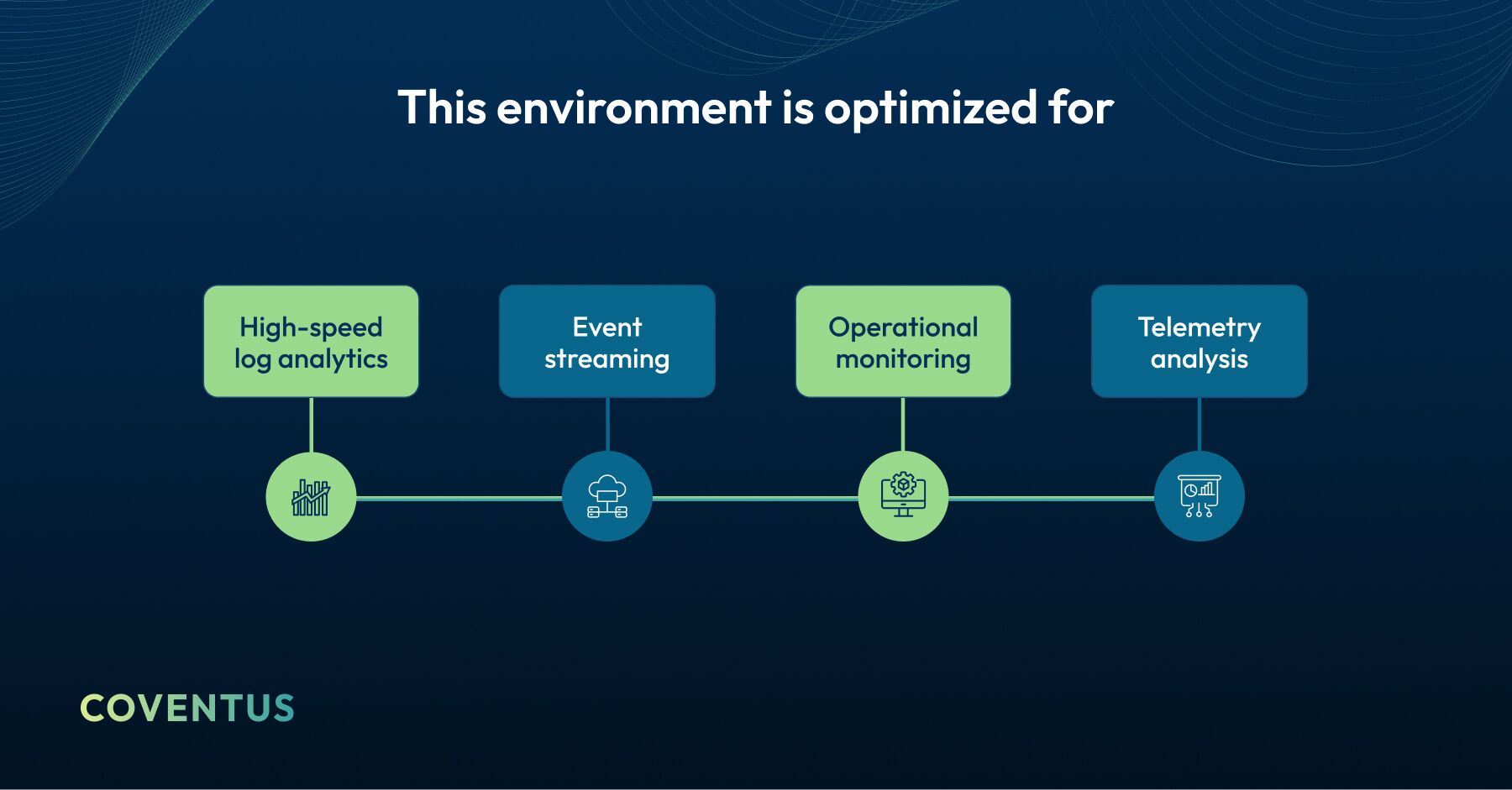
Data Activator for Event-Driven Automation
While Real-Time Analytics focuses on querying and analysis, Data Activator enables organizations to automate reactions to data conditions.
For example:
- Alerting when operational metrics exceed thresholds
- Triggering workflows based on customer behavior
- Automating responses to system anomalies
Together, these capabilities allow organizations to move from reactive reporting to proactive operational intelligence.
Common AI-Driven Analytics Use Cases
Fabric also supports the integration of AI and machine learning models.
Common enterprise use cases include:
- Predictive churn modeling
- Demand forecasting
- Anomaly detection through AI
- Predictive maintenance
- Fraud detection
These capabilities establish Fabric as an AI-first analytics platform rather than merely a reporting platform.
Power BI: The Business Intelligence and Self-Service Analytics Layer
Whereas Fabric provides the data and analytics infrastructure, Power BI delivers the business intelligence experience.
Power BI allows business users to interact with trusted datasets and generate insights without depending on technical teams.
Capabilities of Power BI
Organizations utilize Power BI for:
- Executive dashboards
- KPIs (key performance indicators)
- Operational analytics
- Self-service analytics
- Cross-department reporting
DirectLake Performance Advantages
One of the most powerful capabilities of Fabric is DirectLake mode.
In DirectLake mode, Power BI can query lakehouse data directly from OneLake without duplicating the data into a separate semantic model.
Benefits include:
- Faster performance of dashboards
- Eliminating data duplication
- Real-time analytics experiences
- Simplified architecture
Semantic Model Enhancements
Power BI semantic models enable organizations to create consistent data definitions across reports and dashboards.
Additional capabilities include:
- Centralized business metrics
- Reusable data models
- Reports and DAX queries generated through Copilot
This layer allows organizations to convert raw data into operational insights that inform everyday decision-making.
Governance and Security in Microsoft Fabric
As organizations increase their analytics capabilities, governance and security become increasingly critical.
Microsoft Fabric integrates governance directly into the platform.
Governance Features in Fabric
- Role-based access controls
- Data lineage tracking
- Sensitivity labels
- Audit logs for compliance
- Domain level management
Integration with Microsoft Purview
Fabric also integrates with Microsoft Purview for enterprise data governance.
Purview supports:
- Enterprise data catalogs
- Compliance monitoring
- Policy enforcement
- Automated data classification
Collectively, these capabilities ensure analytics environments are secure, compliant and trustworthy.
Business Benefits of Microsoft Fabric Data Modernization
Companies that adopt Microsoft Fabric typically see significant improvements in analytics performance and operational efficiency.
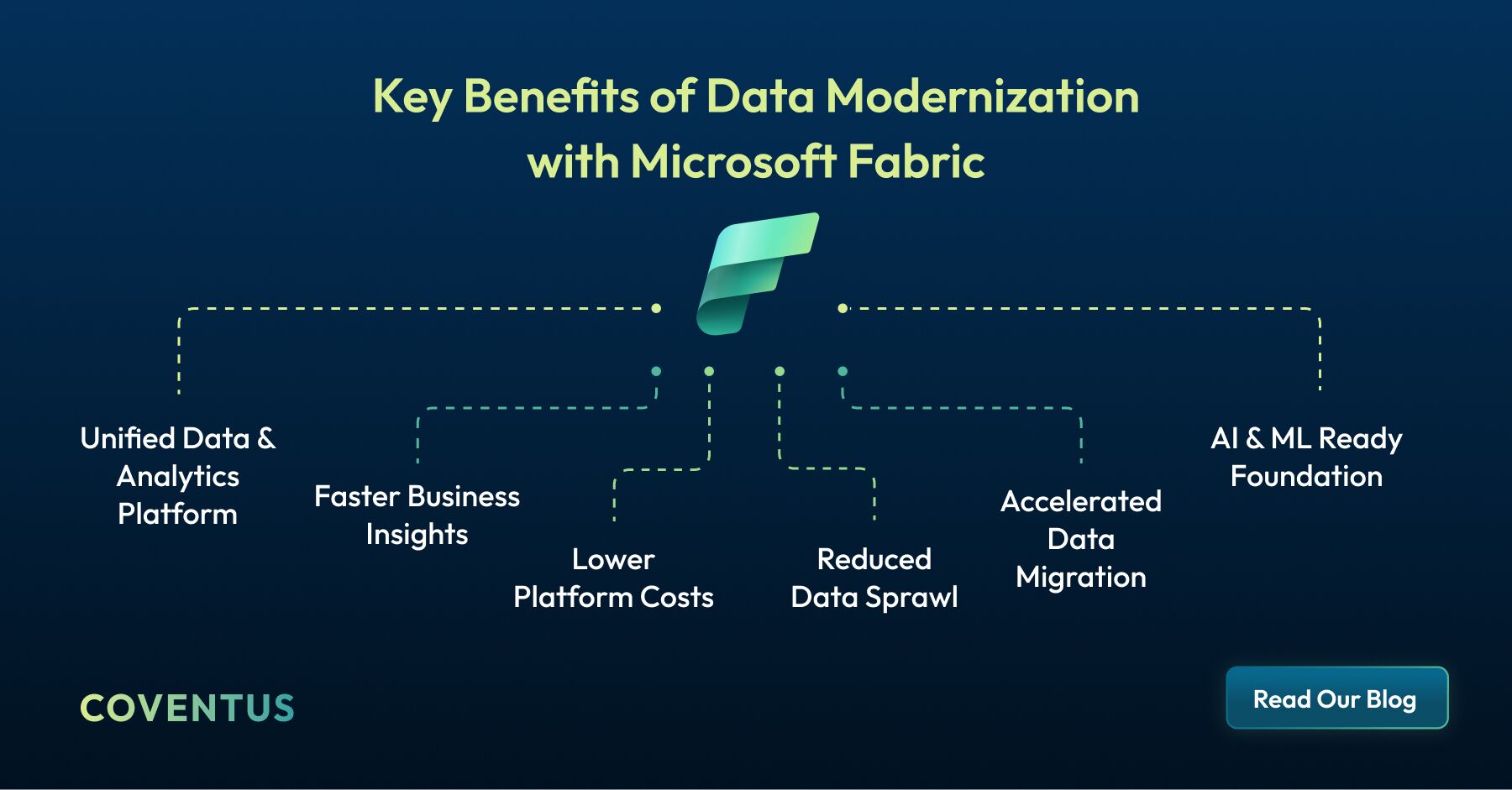
Beyond technical improvements, modern analytics platforms allow organizations to treat data as a strategic asset rather than an operational challenge.
Real-World Analytics Scenarios
A modern analytics platform enables companies to address complex data challenges across multiple industries.
Retail
- Forecasting demand and optimizing inventory
- Customer behavior analytics and personalization
Finance
- Financial performance dashboards
- Automated regulatory reporting
Manufacturing
- Real-time monitoring of production systems
- Predictive maintenance from sensor data
Healthcare
- Patient analytics dashboards
- Population health forecasting
These scenarios illustrate how cloud analytics platforms convert raw data into actionable insights.
The Future of Enterprise Data Analytics
Enterprise data modernization is no longer optional. As organizations generate greater amounts of operational data, they require platforms capable of supporting engineering, analytics, governance and AI within a single environment.
Microsoft Fabric represents a major advancement in the analytics ecosystem.
By combining:
- Unified storage through OneLake
- Integrated analytics workloads
- AI-assisted analytics through Copilot
- Real-time operational intelligence
organizations can build an end-to-end analytics platform that scales with both data growth and AI adoption.
Companies that invest in modern analytics infrastructure today will be well positioned to leverage predictive intelligence, real-time insights, and AI-driven automation in the future.
Getting Started with Data Modernization
For many organizations, the first step toward modernization is to assess their current data architecture and identify areas where analytics environments can be simplified.
This may include:
- Consolidation of legacy data warehouses
- Modernization of ETL pipelines
- Implementation of lakehouse architecture
- Supporting enterprise self-service analytics
At Coventus, we help enterprise teams plan and implement modern Microsoft Fabric architectures to support scalable analytics and AI initiatives.
If your organization is ready to move from fragmented data to a single, AI-ready analytics platform, schedule a free consultation to get started.
Share this article