Personalize your takeaways & insights with AI




Legacy applications have been behind-the-scenes powering the most mission-critical functions of enterprise organizations for almost thirty years.
Legacy applications process transactions.
Legacy applications manage financial systems.
Legacy applications house and protect an organization’s most valuable information.
Departments rely on legacy applications each and every day.
These systems were designed for a completely different environment — pre-cloud native architecture, pre-API ecosystems and many years prior to artificial intelligence becoming a strategic imperative.
Legacy systems are not merely “old.” Legacy systems restrict growth, limit AI implementation and impede speed of innovation. What once supported scale now hinders scale.
Modernization is no longer an IT project. Modernization has evolved to be a strategic enabler to determine if you can leverage AI to increase speed to market, reduce cost to serve, create competitive advantage in a digital first world and drive innovation.
Legacy Systems: The Hidden Obstacles to AI Adoption
Enterprise leaders focus on speed to market, cost to serve, risk to operations, customer experience and ability to innovate. Legacy environments hinder all five.
Legacy environments contain:
- Business logic embedded within the application code
- Coupled integrations tightly linked together
- Structured data silos or rigid data models
- Manually processed workflows
- Low scalability
Monolithic legacy applications, even though they may be hosted in the cloud, remain monolithic. They are difficult to extend, integrate and transform for AI use cases such as:
- Real-time predictive modeling
- Generative copilots
- Automated decision-making
- Intelligent workflow orchestration
Cloud adoption for legacy applications is not the problem. The problem is the architecture of the legacy applications.
Why Lift-and-Shift Fails
Many organizations attempt to modernize legacy applications by relocating legacy applications to the cloud and declare the migration complete.
However:
- A cloud-hosted legacy monolith is still a legacy monolith.
- The technical debt remains unaddressed.
- Data fragmentation remains unchanged.
- AI-readiness is not achieved.
Relocating legacy applications to the cloud increases infrastructure cost but does not increase innovation capacity. True modernization requires transformation — not relocation.
A Modernization Framework Designed for the AI Enterprise
Each successful modernization starts with a comprehensive evaluation.
Coventus’ modernization framework assesses application architecture and dependencies, integration complexity, database structure and quality, security posture, constraints to performance and constraints to scalability.
After completing the evaluation, legacy applications transition to refactoring and re-architecting utilizing cloud-native design principles, including:
- Containerization
- Enabling Application Programming Interfaces (APIs)
- Microservice Architecture
- Event-Driven Design
- Azure-Native Services
- Domain Driven Design
Once legacy applications are modularized through the modernization process, the next most important step is to modernize the data layer — because AI is only as effective as the dataset(s) upon which it learns.
The end product of this process is not simply a modern legacy application. The end product is a scalable platform for innovation.
Replacing Hard-Coded Business Logic with Modular APIs and Microservices
Legacy applications commonly contain business logic embedded within the application code itself. This embedment of business logic creates both rigidity and risk.
All enhancements to the legacy application require full regression testing. All integrations with other legacy applications or external systems require significant custom coding. As complexity of the legacy application increases, stability also decreases.
Modern application architecture separates logic into modular, reusable services, including:
- Decoupled Business Logic
- Re-usable APIs
- Independent Microservices
- Event-Driven Communication
This separation of logic allows organizations to:
- Release applications at a faster rate (e.g., quarterly → weekly → daily)
- Grow individual components independently
- Reduce the cost of integrating legacy applications
- Add AI capabilities without disrupting the entire system
A global manufacturer was able to reduce the processing time for orders by 60% after separating its legacy ERP application and implementing AI-powered exception handling using modern APIs.
Modernization is not about replacing working components. Modernization is about freeing those components.
The AI Integration Layer: More Than Just Buzz Words
Modernized applications form the foundation for intelligent systems; however, intelligent systems require intentional architectural planning for AI.
An AI-enabled enterprise requires:
- API Orchestration Layers for Model Interaction
- RAG Pipelines
- Vector Databases for Semantic Search
- Copilot Extensibility Frameworks
- Oversight Governance Models for Model Oversight
- Methods for Fine-Tuning or Secure RAG Implementations

Instead of developing applications that perform tasks, organizations develop systems that learn, adapt, and improve over time.
AI will not enhance brittle systems. AI will enhance better systems.
Data Modernization: The Underlying Basis of AI
Legacy data environments include databases that operate in isolation, inconsistent database schema, poor data governance and batch-based reporting.
Unless the underlying data architecture is modernized, AI initiatives are stalled.
Modernization includes:
- Unified Cloud Data Platforms
- Real-Time Streaming Pipelines
- Master Data Management (MDM)
- Data Normalization and Cleansing
- AI Ready Schemas
- Secure Governance Frameworks
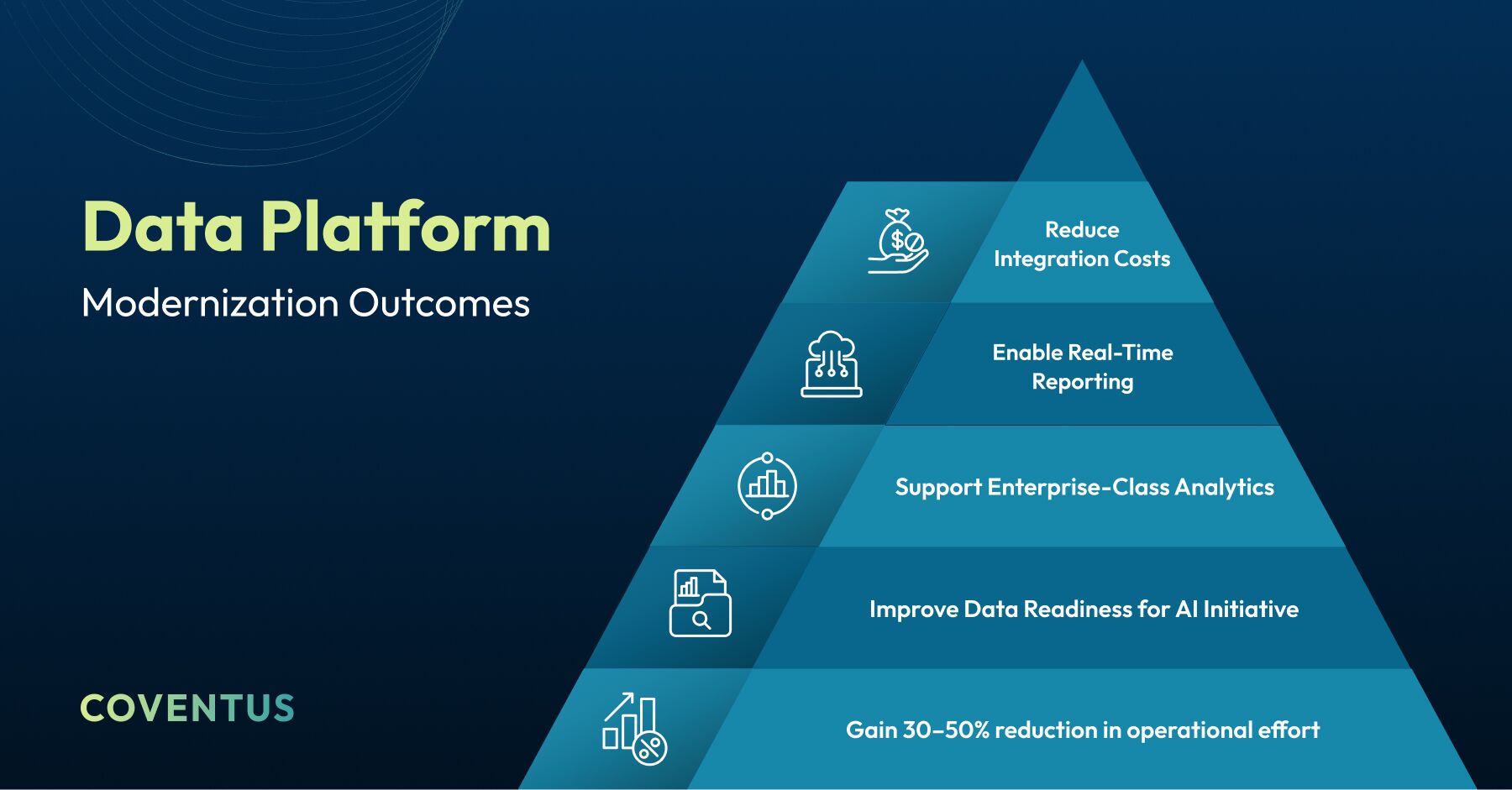
Data Modernization is not a Back-End Function. Data Modernization is the basis of Enterprise Intelligence.
Legacy Application Modernization and AI Readiness
Legacy application development relies on manual releases and rare release cycles; this hinders innovation and expands risks.
The use of modern DevOps practices will bring:
- Automated testing
- Release automation
- Infrastructure-as-Code
- The CI/CD pipeline
- Observability and monitoring
This results in:
- Less frequent production failures
- Decreased operation costs
- Increased product evolution
- Continuous innovation, rather than episodic innovation
Enterprise Benefits of Adopting a Modernized Architecture for an AI-Driven Business
Adopting a modernized architecture for an AI-driven business results in quantifiable benefits, including:
- Lower cost-to-serve
- Less integration overhead
- Higher customer satisfaction
- Less risk exposure
- More innovative capacity
Modernization changes the role of technology from being a cost center to an opportunity enabler. Organizations that view modernization as strategic infrastructure rather than maintenance are better positioned to achieve long-term objectives.
From Legacy Technical Debt to Strategic Assets
Legacy applications were once a source of competitive advantage. Today, many are viewed as technical debt.
With a well designed modernization strategy, those legacy applications can again serve as a source of competitive advantage.
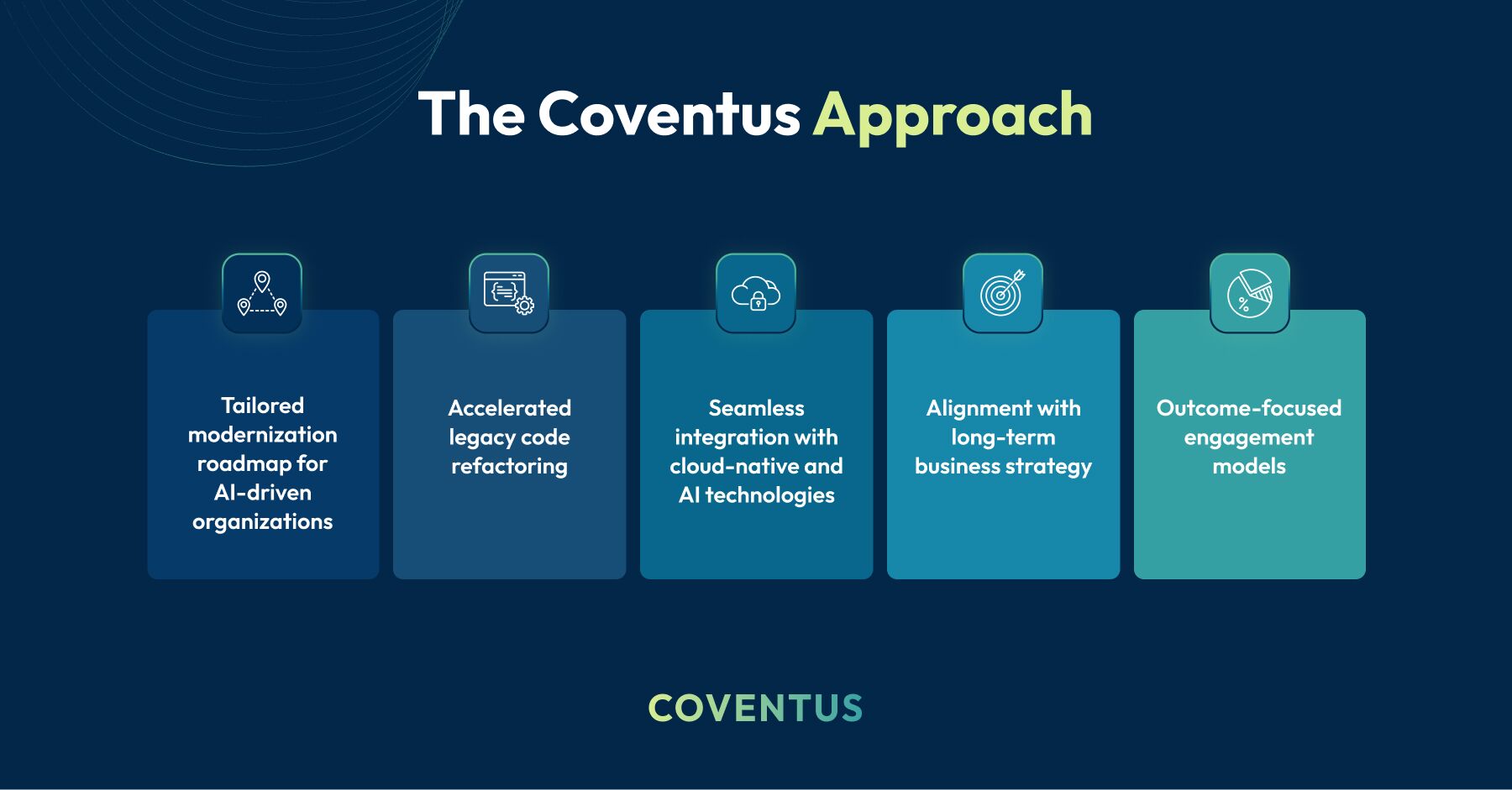
Modernization is not performed simply for the sake of modernization. The objective is to unlock business value.
Modernization is a Strategic Decision
Legacy system modernization is not primarily focused on keeping up with the latest technology trends.
Legacy system modernization provides a foundation to support:
- Operational efficiencies
- Digital transformation
- Long-term innovation
- AI enabled enterprise initiatives
Companies that include AI-readiness in their modernization strategy from the outset of the process receive the greatest returns on investment.
Conclusion
You are not replacing functioning legacy applications. You are unlocking their potential.
Identify where you currently are.
Improve/refactor legacy applications to provide additional functionality.
Re-design legacy applications to improve scalability.
Layer AI capabilities over legacy applications.
Implement DevOps processes to enable ongoing sustainment of legacy applications.
Legacy applications need not constrain your business. Using the right strategy, legacy applications can provide the foundation upon which your company can create a platform for enterprise intelligence.
For organizations evaluating legacy application modernization or developing AI-enabled enterprise initiatives, Coventus can support the design of an AI ready and scalable foundation for innovation.
Share this article