Personalize your takeaways & insights with AI





Introduction: Why Mobile Apps Fail Businesses (Not the Other Way Around)
Most mobile apps fail for reasons other than poor concepts.
They fail due to being created with insufficient planning for what comes next.
And so, scalable mobile app solutions are essential for ensuring your business has sustainable growth.
An organization creates a mobile app that experiences positive initial traction. Users start signing up for the app, using the app and the internal stakeholders have labeled the app as a success. But then, as the app reaches some level of scale, things begin to shift.
The response times for the app increase. More bugs begin to appear. And, it takes longer to deliver the new features. What may have felt like momentum turns into friction.
This is when organizations begin to realize that the problem was not the idea, but rather the foundation.
Scalability is not simply a technical consideration after the app has been launched; it is a strategic decision regarding whether or not the app will continue to produce growth, or if it will inhibit it.
Additionally, according to research from Google, even minor delays in response time can negatively affect user engagement. For example, every 100-millisecond delay in response time, can result in a 1% increase in bounce rate.
What "Scalable Mobile App Solutions" Really Mean for Businesses
Scalable mobile app solutions are not merely a technical concept; they are a business outcome.
In both enterprise mobile app development and consumer facing mobile applications, scalable mobile app solutions will prevent the growth of an organization from turning into a technological bottleneck.
At its most basic form, scalability refers to the ability of an application to grow — providing for increasing numbers of users, increasing amounts of data and supporting increasing numbers of features — while maintaining performance and preventing exponentially increasing costs.
Think of it like creating a physical retail storefront.
If an organization develops a location that only provides enough room to accommodate opening day foot traffic, the location will rapidly become overwhelmed by growing demand. Similarly, mobile applications function under the same rules.
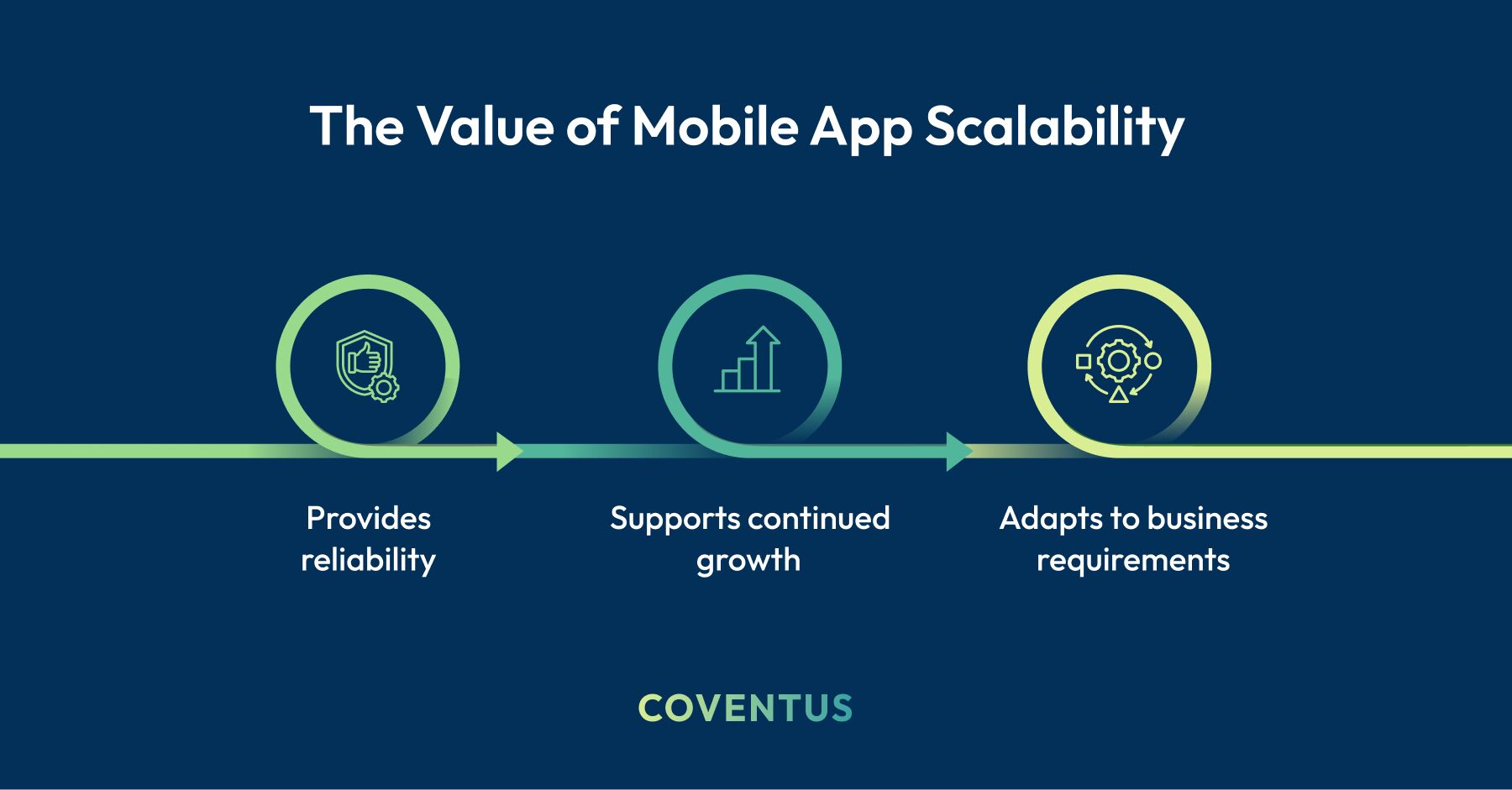
According to Gartner, organizations that develop scalable digital architectures are better positioned to respond to future changes in their marketplace.
Scalable apps do not merely support growth.
They enable growth.
The Business Cost of Non-Scalable Mobile Applications
When Growth Becomes A Burden
A successful marketing campaign generates traffic. Downloads are generated.
However, rather than taking advantage of momentum, the app either slows down or, worse yet, crashes.
Growth becomes an impediment to the organization, rather than an asset.
Unexpected Costs As Usage Increases
Many apps were developed based upon current demand, and not anticipated growth.
As the usage of an app increases, the underlying infrastructure finds it difficult to keep pace.
Teams are forced into short term fixes to correct performance problems, rather than developing long-term solutions.
Initially, the perceived cost savings of a non-scalable app ultimately prove to be costly.
As noted by McKinsey & Company, technical debt can significantly add to an organization’s expenses, while also impeding innovation.
When Performance Negatively Affects User Trust
Users are extremely sensitive to performance issues.
A slow or unresponsive app does not merely cause frustration.
It erodes trust.
And, once that trust is lost, it is difficult to recover.
Difficulty Adapting To Changes
Adding new markets or features to an app should feel like a step in the right direction.
However, tightly integrated systems create ripple effects when changes occur.
Teams are hesitant to make changes.
As outlined in Deloitte’s digital transformation research, many organizations are reluctant to change because of the fear of causing disruption to existing systems.
How Scalable Mobile Apps Provide Solutions to These Problems
Scalable mobile apps are designed to provide a basis for growth — not react to it.
Scalable apps maintain consistent performance through periods of peak demand.
They also allow organizations to predictably manage costs as usage increases.
This is the defining feature of high-performance mobile apps in today’s environment.
But the largest benefit is in terms of speed.

These advantages apply to both native iOS and Android applications, as well as hybrid and cross-platform mobile apps that are designed to provide accelerated entry into markets.
According to Amazon Web Services, scalable systems provide faster innovation cycles, as well as increased operational efficiencies.
“Growth should feel like momentum, not maintenance.”
This is the difference between reacting to change, versus leading it.
Choosing the Right Approach to Build Your Mobile App: Native, Hybrid or Cross-Path
Not all mobile app approaches are created equal.
The right approach to creating a mobile app is based upon business objectives, and not solely based upon technology.
Native apps are best suited when performance and device specific functionality are paramount.
However, native apps generally require more time and resources to develop.
Hybrid and cross-platform apps allow organizations to deploy mobile apps on multiple platforms utilizing a single code base, thus enabling faster development, and lower costs.
Frameworks such as React Native make this possible.
Regardless of whether you choose to develop native iOS and Android applications or hybrid and cross-platform solutions, the ultimate objective is the same — balancing performance, speed-to-market, and long-term scalability.
The key to selecting the right approach is alignment.
The best approach is not about selecting the “right” technology.
It is about selecting the approach that best fits your business strategy.
Building for Scale From Day One
Scalability is not something that is added later.
Scalability must be built into the design of the app.

This perspective is aligned with the architectural strategies utilized by companies such as Netflix, which utilize microservices to scale globally, without degrading performance.
Building for scale early on prevents costly and potentially debilitating rebuilds later.
Performance, Security and Reliability at Scale
As an app scales, so do the expectations of the users.

For high-performance mobile apps, consistency is more important than raw speed.
Consistency refers to the ability to consistently provide quality performance — regardless of the number of users.
According to Akamai Technologies, a one-second delay in performance can result in significant reductions in conversion rates.
Secure mobile app development becomes increasingly important as the amount of data increases, and the size of the system expands.
Security becomes more complex as data volumes grow — requiring enhanced access controls and robust infrastructure.
Reliability ensures uptime during periods of peak usage.
Downtime is not merely a technical concern — it is a business risk.
Scaling Beyond the Launch
Launching a mobile app is not the end-game.
It is the beginning.
As organizations grow, their mobile apps must grow with them — supporting larger numbers of users, entering into additional geographic regions, and delivering additional features.
As Microsoft Azure notes, scalable systems are essential for maintaining performance and uptime within distributed systems.
Scalable apps do not merely endure growth — they adapt to it.
Why the Right Partner Matters
Not all development partners are capable of building scalable mobile apps.
Scalability is not merely a matter of technical proficiency.
Scalability requires business acumen, forward-thinking, and the ability to envision potential complexity before it becomes a challenge.
Teams that possess experience in both enterprise mobile app development and consumer facing mobile applications, as well as cloud-based systems are more likely to be prepared to anticipate scalability challenges.
The right partner aligns business decisions related to technology with business results, and ensures that scalability is embedded into the foundation of the app — not added later.
Because scalability is not merely a matter of infrastructure — it is a matter of vision.
Conclusion: Build an App That Grows With You
Mobile apps are no longer optional.
They are required.
But not all mobile apps are designed to last.
Scalable mobile app solutions are designed to provide the necessary performance today, while planning for the necessary growth tomorrow.
They protect performance, they control costs, and they empower innovation.
Most importantly, scalable mobile app solutions provide organizations with the confidence to grow without hesitation.
Because the best apps do not merely launch successfully.
They scale successfully.
Build for Growth — Not Just Launch
If you are considering developing — or scaling — a mobile app, the discussion should not begin with features.
It should begin with the foundation.
Coventus is focused on designing and developing scalable mobile app solutions that support performance, security, and long-term growth — in both enterprise mobile app development and cross-platform solutions, as well as high-performance applications.
Share this article