Personalize your takeaways & insights with AI


Executive Summary
A mid-sized enterprise operating mission-critical legacy systems felt increasing pressure to speed up its digital transformation and embed AI-enabled enterprise solutions into key business workflows.
These legacy applications were monolithic and tightly coupled, making them very difficult to scale, and they were not designed to support modern AI modernization services. Although stable, these systems restricted innovation, limited integration opportunities, and prevented the use of AI-powered automation.
The enterprise adopted a legacy application modernization strategy to enable a long-term transition from legacy to AI.
Key areas of focus of the transformation included:
- Re-architecting legacy applications for cloud-native, AI-enabled environments.
- Replacing hard-coded logic with modular APIs and microservices.
- Embedding AI and automation directly into workflows.
- Modernizing data platforms to support real-time analytics.
- Implementing DevOps automation to reduce risk and increase delivery efficiency.
The result was a scalable, AI-enabled enterprise platform capable of supporting continued innovation.
The enterprise application modernization initiative produced significant benefits across defined outcome categories:
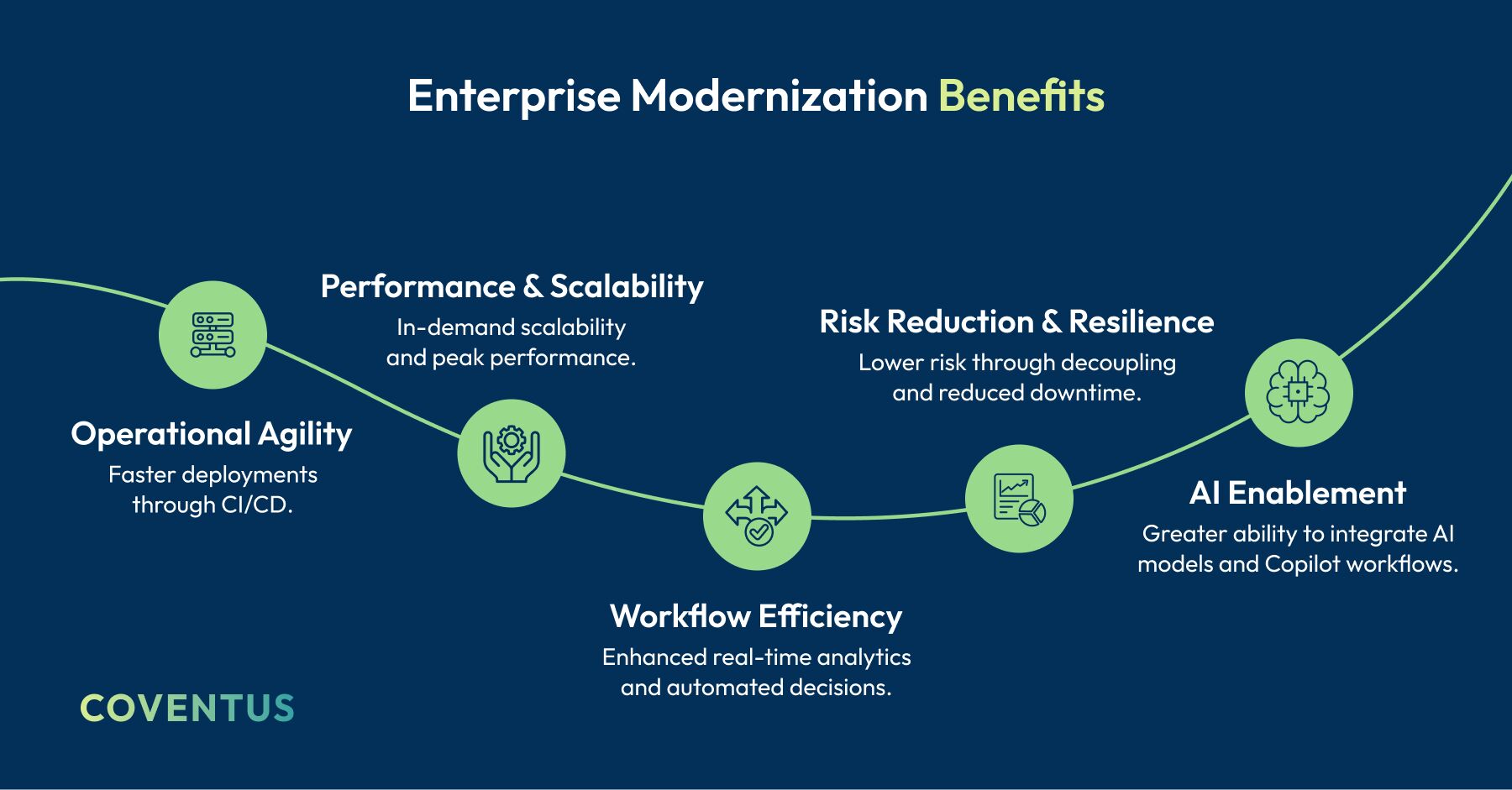
Operational Agility
Increased deployment velocity through CI/CD automation.
Performance & Scalability
Increased scalability under peak demand.
Risk Reduction & Resilience
Reduced operational risk from system decoupling and reduced downtime.
Workflow Efficiency
Strengthened the organization’s ability to provide real-time analytics and automated decision support.
AI Enablement
Greater ability to integrate AI models and Copilot workflows.
Modernization strengthened performance, agility, and capacity for innovation while reducing dependency on tightly coupled integrations.
Research has repeatedly shown that a legacy modernization architecture aligned with cloud-native design reduces technical debt and increases readiness for AI-enabled enterprise solutions.
Client Profile
The organization operates within the enterprise services industry and is structured as a mid-sized enterprise.
Its environment consisted of legacy on-premise applications transitioning to Azure, built around monolithic applications supporting:
- Multi-department operational workflows.
- High-volume internal process automation.
- Transactional systems.
- Document processing and reporting workflows.
- Integrations with other systems supported by a legacy middleware stack.
System performance and reliability directly impacted business continuity, revenue stability, and user experience.
Business Challenges
While the legacy applications had served the organization for many years, their architectural constraints were now limiting growth and AI adoption.
The primary constraints included:
- A monolithic application structure with embedded business logic across application layers.
- Lack of API exposure and flexible integration options.
- Outdated database schemas and data silos limiting analytics and AI readiness.
- Manual release processes hindering innovation.
- Growing infrastructure and support costs.
The lack of structural transformation made it impossible to integrate AI effectively into legacy systems. The organization needed enterprise application modernization — not simply a new hosting option.
Modernization Approach
Coventus structured the modernization into five sequential phases, each designed to build on the last.
First, the organization assessed, refactored, and rearchitected legacy systems for cloud-native, AI-ready environments.
Second, embedded business logic was replaced with modular APIs, microservices, and event-driven architecture.
Third, AI and automation capabilities were embedded into modernized workflows.
Fourth, data platforms were modernized to support AI readiness and real-time analytics.
Fifth, DevOps, CI/CD, and automation were implemented to increase speed and decrease risk.
The transformation was completed in staged phases to minimize disruption and ensure operational continuity.
Phased Implementation

Phase 1: Assess, Refactor, and Re-Architect
A thorough architectural review was conducted to assess system interdependencies, integration complexity, data quality and schema design, security posture, and scalability limitations.
Refactoring activities included containerizing legacy components, enabling APIs for core services, decomposing microservices, adopting an event-driven communication model, and re-platforming to Azure.
The result was increased architectural flexibility, increased scalability and performance, decreased technical debt, and a foundation laid for AI integration.
Phase 2: Modular Architecture
The organization transitioned to modular API-driven services, including reusable API services, independently deployable microservices, event-driven communication models, and decoupled business logic.
The effect was:
- Ability to update independently.
- Reduced downtime during releases.
- Ability to scale independent high-demand services.
- Ability to integrate AI capabilities without rewriting entire systems.
Phase 3: AI Integration & Intelligent Automation
AI capabilities were embedded into operational workflows, including predictive insights and forecasting, intelligent document processing, automated anomaly detection, conversational AI interfaces, and real-time decision support.
The impact included improved decision-making accuracy, automation of tasks that require human judgment, faster workflow completion, and improved user experience.
Phase 4: Data Modernization for AI Readiness
The organization modernized its data environment to remove silos and enable real-time analytics through:
- Migrating to managed Azure data platforms.
- Implementing data cleansing and normalization.
- Establishing unified data pipelines.
- Adopting a streaming architecture.
- Implementing governance frameworks.
The outcome included reliable real-time insights, accurate analytics, and a data foundation ready for Copilot and next-generation AI models.
Phase 5: DevOps Automation & Governance
Manual release processes were replaced with modern DevOps pipelines, including CI/CD automation, infrastructure-as-code, automated testing gates, centralized monitoring, Role-Based Access Control (RBAC), and policy-as-code governance.
The outcome was higher release velocity, lower production risk, improved predictability of costs, and ongoing innovation capability.
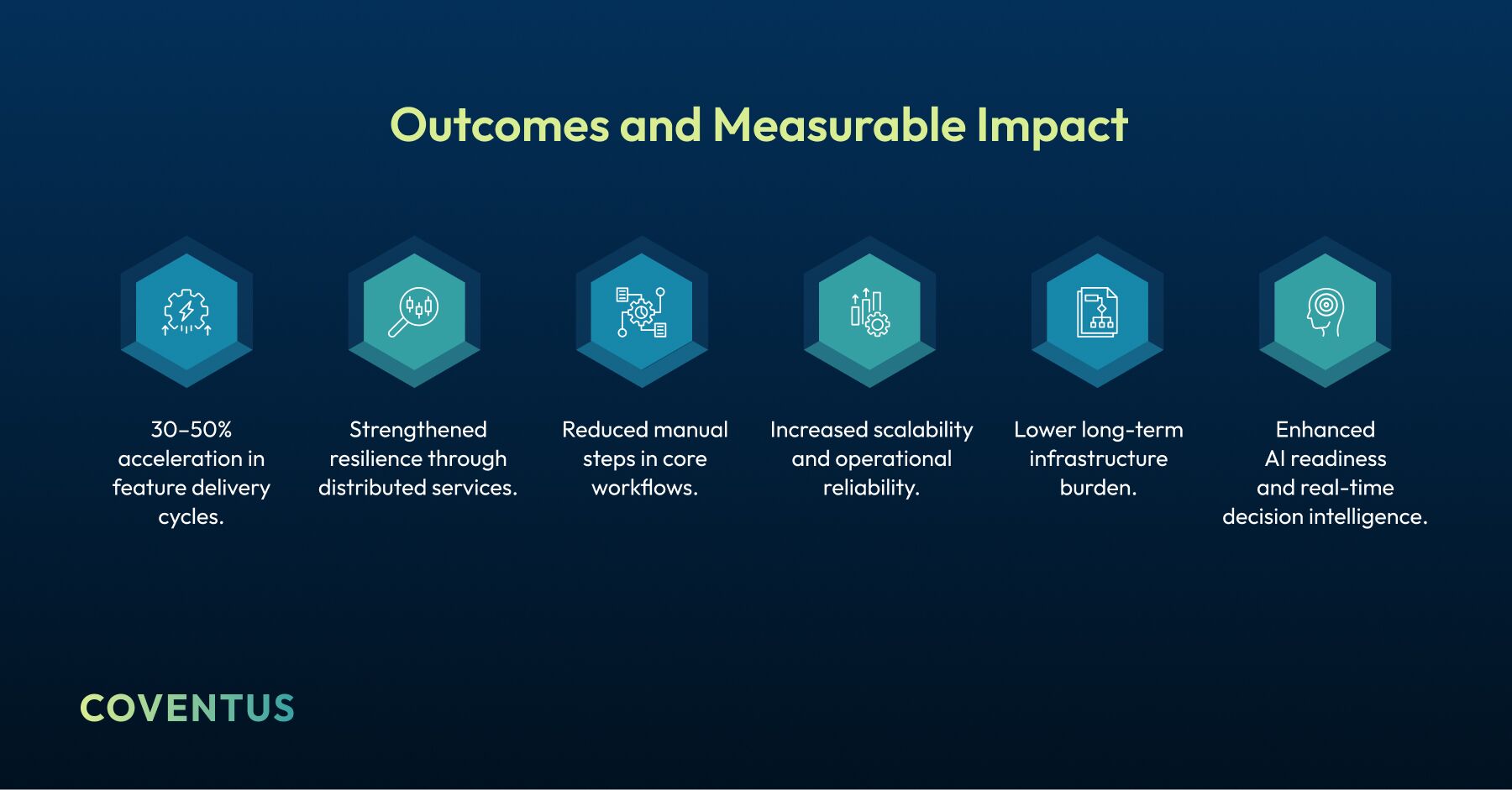
The organization transitioned from maintaining legacy systems to operating an adaptable digital platform.
Legacy modernization architecture is now foundational to the organization’s overall digital transformation roadmap.
Governance, Risk & Compliance
Security and governance were integrated into the modernization framework.
Controls implemented include:
- Role-Based Access Control (RBAC)
- Policy-as-code enforcement
- Secure API governance.
- Compliance frameworks for modernized data platforms.
This reduced integration vulnerability and improved governance maturity.
As part of structured digital transformation consulting, governance was addressed as an architectural requirement rather than an afterthought.
Lessons Learned
Legacy application modernization is not migration; it is structural transformation.
Structural transformation requires architectural redesign, modularization, data modernization, strategic AI integration, DevOps automation, and disciplined governance and cost management.
The legacy environment was transformed into an AI-enabled enterprise platform capable of supporting sustainable long-term growth.
Share this article