Personalize your takeaways & insights with AI




Executive Summary
Most enterprise AI programs remain trapped in conversational sandboxes. While they excel at summarizing documents and answering queries, they lack the capability to execute work. AI-based workflow automation is fundamentally different: it plans, executes, and governs workflows end-to-end, maintaining a rigorous audit trail at every step.
For regulated enterprises, effective adoption depends on more than the technology. Governance, accountability, system access, human oversight, and audit requirements must be defined before agentic workflows are deployed. Establishing these foundations early can reduce control gaps and avoid costly redesign as adoption expands.
Key points:
- Most AI programs stall because they focus on conversation rather than operational execution.
- Digital leaders are accountable for the compliance and audit outcomes of every AI-driven decision, regardless of whether that accountability has been formally assigned.
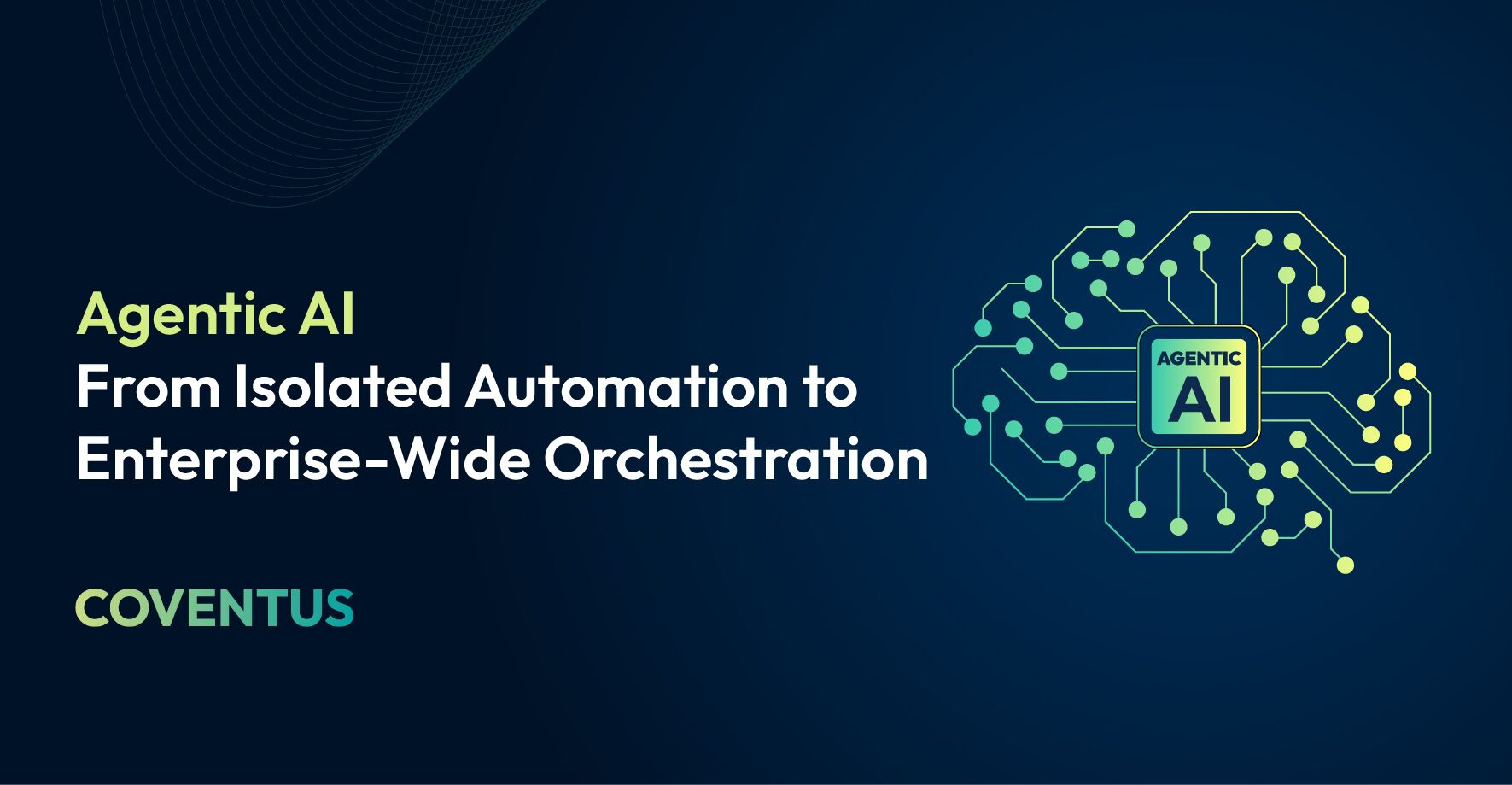
- Agentic AI represents a paradigm shift from isolated automation to enterprise-wide orchestration.
- Delayed adoption can preserve inefficiencies, while ungoverned adoption can increase operational and compliance risk.
- Building the governance operating model prior to scaling is measurably faster and lower-risk than scaling first and governing later.
Why Most Enterprise AI Stalls
Every Digital Leader is already fielding some version of these questions internally:
- How do we govern AI-enabled decisions?
- Who is accountable when an automated decision causes a problem?
- How do we remove friction from our processes without loosening the risk controls we are required to maintain?
Most organizations lack adequate answers because current AI deployments were never architected to address compliance at the decision level. Copilots that summarize meetings, assistants that answer customer questions, and search tools that surface documents faster are undoubtedly useful, but they all stop at the same boundary. They produce an answer and hand the remaining labor back to a human employee. Someone still has to take that answer, log into three separate systems, coordinate the approval, and manually document the workflow.
That manual handoff is where real operational costs accumulate. Every manual step is a place where the process can break, where documentation can go missing, and where two employees can end up handling the same situation in two different ways. This inconsistency is precisely what regulators flag. In a regulated environment, “the tool gave a good answer” was never actually the requirement. The requirement was always: was the decision made consistently, was it documented, and can we prove it if asked.
That gap between a good answer and a defensible, executed, audited action is no longer just an operational inconvenience. It is now a board-level ROI conversation because organizations have already spent real budget on AI tools that produce insight without producing outcomes.
What Agentic AI Actually Does
Agentic AI differs from conversational tools in a specific, measurable way: rather than answering a question, it takes an objective, breaks it into steps, gathers the information it needs from relevant systems, and carries the work through to completion within defined guardrails.
Insurance claims processing is a useful example. An agentic AI system can:
- Validate policy terms against the policy record
- Flag missing or inconsistent documentation
- Initiate the correct approval workflow without manual triggering
- Escalate exceptions to a human reviewer when needed
- Generate an audit log as each action occurs
A detail that is often left out of agentic AI explanations: this typically is not a single agent handling every step. It works more like an orchestration layer, where multiple specialized agents each manage a distinct part of the process and coordinate with one another under shared governance rules. One agent may handle document validation, another handles policy checks, another manages exceptions and escalation.
This architectural distinction is critical in regulated environments. A single agent responsible for an end-to-end process is a single point of failure and a single point of audit exposure. A set of coordinated agents, each with a narrower and well-defined responsibility, is easier for an organization to monitor, validate, and defend to regulators.
The Coventus Agentic AI Operating Model
Coventus builds this as a governed, multi-agent operating model, one designed to close the distance between insight and execution rather than stop at insight.
Within this model, agents:
- Initiate multi-step workflows across systems that do not otherwise talk to each other.
- Update records and trigger approvals automatically, without waiting for a manual handoff.
- Coordinate with other agents that own adjacent parts of the same process.
- Generate audit logs as each action is taken, not reconstructed after the fact.
For insurers, this means agents capable of managing a full claims review cycle, flagging exceptions as they arise, and maintaining a complete record of actions taken. For banks, it means agents that manage document verification and approval routing without manual handling between departments.
This governance is not added after deployment; it is built in from the start, aligned with frameworks regulated organizations already operate under, including NIST’s AI Risk Management Framework and the Federal Reserve’s SR 11-7 Model Risk Management guidance. As a result, the audit trail an agent produces is one a compliance team can rely on.
The Real Cost of Fragmentation
Ask any healthcare coordinator or bank lender where their day actually goes, and the honest answer usually is not any single broken process; it is the constant switching between systems just to do routine work. Verifying a document in one system, checking compliance status in another, confirming an update landed correctly in a third. Each switch is small. The accumulation is not.
Underneath that switching sits a second problem: the knowledge people are working from usually is not centralized. It lives across policies, PDFs, email threads, and legacy systems that were never designed to talk to each other. When someone makes a decision based on an outdated policy or an inconsistent version of a document, the result is not just an internal error; it is a misstated claim, a missed regulatory requirement, or a failed audit finding.
Department-level automation, such as legacy RPA bots built to solve one team’s isolated problem, tends to compound this fragmentation over time.
Each isolated automation layer adds yet another component that must be separately governed, maintained, and updated whenever a business rule or underlying regulation changes.
Agentic AI eliminates the need for manual switching. Agents pull approved, real-time information directly from every governed system a task requires, and act on it. There are no separate logins, no manual lookups, and zero version confusion regarding which document is current.
Why Now
Gartner and McKinsey have independently arrived at the same conclusion from different data: the gap between AI leaders and AI laggards is not about who has access to the best models. Everyone increasingly has access to roughly the same models. The real differentiator is operational execution: which organizations can deploy these models safely, consistently, and at enterprise scale while competitors remain stuck running perpetual pilots?
Organizations that build their governance operating model before they scale consistently move faster and take on less risk than those attempting to patch governance onto active, unmanaged AI initiatives. That ordering: governance first, scale second, is the single clearest predictor of which organizations end up ahead.
Coventus helps organizations make that transition: from standalone AI pilots to a safe, compliant, governed agentic AI operating model, with measurable results from day one.
Frequently Asked Questions
Moving from AI pilots to production-ready AI transformation means building governance, accountability, and audit requirements before scaling. That sequencing delivers measurable business results faster and with less risk.
Agentic AI can automate end-to-end business workflows through coordinated, specialized agents that escalate exceptions for human oversight and generate audit logs, supporting regulatory compliance at every step.
AI agents work as an orchestration layer, pulling real-time data directly from existing banking or insurance systems. No rebuild of core technology infrastructure is required.
Assign each AI agent a narrow responsibility, explicit permissions, decision boundaries, escalation paths, monitoring, and accountable owners. Capture every action in real time and align controls with established risk-management and regulatory frameworks.
A regulated enterprise should scale agentic AI only after establishing governance and audit requirements. Multi-agent architecture, rather than one agent doing everything, strengthens auditability, explainability, and accountability.
Share this article